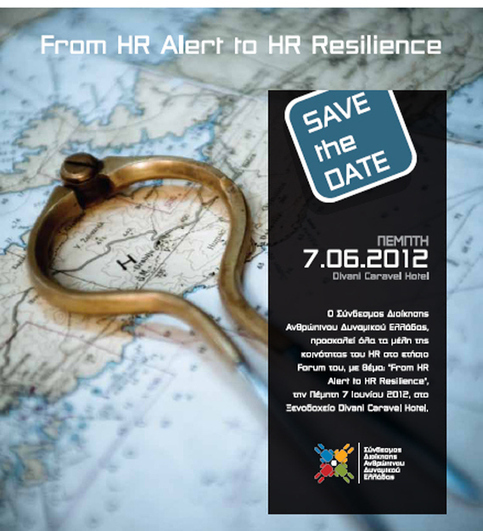
HR Forum 2012 – From HR Alert to HR Resilience -Πέμπτη 7 Ιουνίου – 2012, Divani Caravel Hotel – Μείνετε συνδεδεμένοι και στηρίξτε την κοινότητα του ΗR !
See on gpma.gr
Καθηγητής Οργανωσιακής Συμπεριφοράς & Διοίκησης Ανθρώπινου Δυναμικού
HR Forum 2012 – From HR Alert to HR Resilience -Πέμπτη 7 Ιουνίου – 2012, Divani Caravel Hotel – Μείνετε συνδεδεμένοι και στηρίξτε την κοινότητα του ΗR !
See on gpma.gr
See on Scoop.it – personnel psychology
TED Talks The circumstances of our lives may matter less than how we see them, says Rory Sutherland. At TEDxAthens, he makes a compelling case for how reframing is the key to happiness.
See on www.ted.com
See on Scoop.it – personnel psychology
HR Forum 2012 – From HR Alert to HR Resilience -Πέμπτη 7 Ιουνίου – 2012, Divani Caravel Hotel – Μείνετε συνδεδεμένοι και στηρίξτε την κοινότητα του ΗR !
See on gpma.gr
Όπως λέω πολύ συχνά τελευταία. Η αναζήτηση εργασίας είναι full-time job και απαιτεί ανθεκτικότητα, αντοχή (resilience) και υπομονή…
Το ακόλουθο άρθρο είναι από το Forbes:
A new study by Connie Wanberg, Associate Dean at the University of Minnesota’s Carlson School of Management and three other academics, takes a look at what happens to people’s mental health when they lose their jobs, and how their mental states fare in the 20 weeks that follow. From a low right after getting laid off, most people experience a steady improvement in their sense of well-being. Then, if they haven’t found a job 10-12 weeks into their search, the trend reverses and they start feeling rejected and depressed.
Wanberg tracked 177 unemployed people over the course of 20 weeks by sending them weekly online surveys. Those who engaged in more intense job searches exhibited better mental health than those who were more relaxed about looking for work. The researchers measured mental health by asking respondents to rate themselves on a six-point scale in response to questions like, “have you felt downhearted and blue?”
The study, which is published in the current issue of The Academy of Management Journal, underlines what is most difficult about looking for a job. It is a lonely, unpredictable process with no rules, no guarantees, no supervision and a huge amount at stake. As Professor Wanberg writes in the paper, “Looking for a job is an unfolding task that is highly autonomous, self-organized, loosely structured, and ill-defined. Individuals must decide on their own how and how often to search, and they rarely receive feedback about the effectiveness of the job-search activities and the strategies they are using.” In other words, both motivation and reward must come from within. When rejections start to pile up, it can be incredibly difficult to keep slugging.
One intriguing statistic from the study: Though career professionals say that job seekers should treat their search like a full-time job, participants in the study spent only 17 hours a week on their search at the outset. That declined to 14 hours a week at week 15, and then ticked up slightly after that. The lesson here, say the researchers: Track the amount of time you spend on your search and bump up your effort if you find it lagging.
A piece of good news: even in this depressed job climate, 128 or 72% of the study participants found a job within the 20-week study period.
The biggest lessons from the study: Not only is finding a job in your own hands but so is your mental health, which is directly linked to your ability to push ahead with your job search. Though looking for a job can be one of the toughest tasks in life, especially when you’re feeling down, it’s incredibly important to soldier on. Remaining jobless and not trying to find work takes a toll on self-esteem and overall mental health. Networking and going on informational interviews is horribly tough when you’re feeling low, but it pays off in self-esteem and ultimately, in your ability to land a job.
As I’ve written many times, job seekers should limit their time online and make an effort to get out and meet people face to face. Most people still find work through people they know.
Source: Forbes
Projects Are the New Job Interviews – Michael Schrage – Harvard Business Review.
Resumes are dead. Interviews are largely ineffectual. Linked-In is good. Portfolios are useful.
But projects are the real future of hiring, especially knowledge working hiring. No matter how wonderful your references or how well you do on those too-clever-by-half Microsoft/Google brainteasers, serious firms will increasingly ask serious candidates to do serious work in order to get a serious job offer.
Call them «projeclications» or «applijects.» World-class talent will engage in bespoke real-world projects testing their abilities to deliver real value on their own and with others. Forget the «What’s Your Greatest Weakness?» interrogatory genre; the real question will be how well candidates can rise to the «appliject» challenge and help redesign a social media campaign, document a tricky bit of software, edit a Keynote presentation, produce a webinar or peer review a CAD layout for a contract Chinese manufacturer.
Exploitive? Perhaps. But most organizations have learned the hard way that no amount of interviewing, reference checking and/or psychological testing is a substitute for actually working with a candidate on a real project. I know advertising agencies that have an iron-clad, inviolable rule that they will only hire creatives who have successfully done freelance work with an account team. Similarly, a fast-growing Web 2.0 «software as a service» company doesn’t waste its time asking coding candidates trick «Python» questions during job interviews; they have potential hires participate in at least two «code reviews» to see what kinds of contributors, collaborators and critics they might be.
Yes, candidates must sign NDAs. Yes, sometimes these sessions effectively pit a couple or three candidates against each other. But there’s nothing fake or artificial about the value they’re expected to offer. These organizations treat hiring as part of their on-boarding process. Hiring becomes more holistic rather than «over the wall.» More importantly, everyone in the enterprise now «gets» that people only get hired if and only if they deliver something above and beyond a decent track record and social graph.
Ethically, the most interesting behavior I’ve observed is that firms exploring «projeclication» hires aren’t asking for free labor. They’re paying below-market rates for their candidate’s insights and efforts. If I were a 20-something coder or a forty-something marketer, I’d undeniably have mixed feelings about giving my best efforts for discount compensation. That said, it’s worth something to know what it’s like to really work with one’s colleagues on a real project as opposed to the all-too-misleading charade of iterative interviews. To my mind, this approach is an order of magnitude more ethical than the «free» and unpaid internship infrastructure that has gotten so out of control in so many industries.
But just as many organizations have grown more skillful conducting Skyped interviews and using web-based quizzes and questionnaires as qualifying screens for candidates, my bet is we’ll soon see new genres of project-based hiring shape enterprise human capital portfolios. Facebook and Linked-In are obvious venues for «app-sourced» — that’s «app» as in applicant, not application— business project design. Increasingly, project leaders will design milestones and metrics that make incorporating job candidates into the process more seamless and natural. College graduates, MBAs and older job candidates will learn how to sniff out which «applijects» are genuine invitations to success and which ones are sleazy bids for cheap labor. In the same way job candidates learn how to interview well, they’ll get the skills to «appliject» well because they understand how to optimize their influence and impact within the constraints of the project design.
Ultimately, the reason why I’m confident that «projects are the new job interviews» is not simply because I’m observing a nascent trend but because this appears to be a more efficient and effective mechanism for companies and candidates to gain the true measure of each other. Designing great applijects and projeclications will be a craft and art. The most successful utilizers will quickly be copied. Why? Because the brightest and most talented people typically like having real-world opportunities to shine and succeed.
Should your next hire come from a great set of interviews and references? Or from knocking your socks off on a project?

 ΙΩΑΝΝΗΣ ΝΙΚΟΛΑΟΥ